
Interview with Jiawa Liu

Can you take us back to the beginning - where were you born, how did your creative path first unfold, and what threads have led you here?
I bought a Guillmaud notebook in my first year living in Paris that had the title 'Amour des commencements', which means 'love for beginnings'. I think this kind of sums my whole life up.
I was born in China and migrated to Australia at age 9 to rejoin my parents who had left a few years earlier, so my life started with a really world shattering change that I think made me someone who is not just comfortable with new journeys, but maybe knowing only this way of life. Since then I've had many new beginnings. During highschool I pursued digital illustration for many years, in my last years of law school, I ran a hobby shop in Perth, and after graduating, I worked in Japan for about two years as an English teacher, before returning to Australia to practice law in Canberra. Then, after a 7 year career as a lawyer, I moved to Paris for another new beginning.
 |
 |
You made a bold shift from Perth/Australia to Paris - what was the internal conversation that led to saying yes to that change? And how did you prepare (or not) for living abroad in a city so iconic?
I'm not really what you'd call a real risk taker. I had been building up a side hustle as a blogger and had assured myself that I could financially support myself before making the move, so it wasn't really a leap of faith. One thing I was sure of, was that from day one that I landed in Paris, I felt more at home there than anywhere I had travelled, and there really was no rational thought process but more of an intuition that I wanted to live here for the foreseeable future. Now that it's been almost a decade, Paris has become the place where I have stayed the longest.
I didn't speak a word of the language - truthfully I didn't even know how to say 'bonjour'. That irrational 'at home' feeling gave me this blind confidence that I would just figure things out. I think you do need this kind of not-think-too-much attitude in France, otherwise the stress of culture shock and bureaucracy might begin to outweigh the pleasure of living in such a beautiful city. The dark side of French-ness is that every little thing you need to do here takes a filing cabinet of paperwork, and even the French struggle to navigate it. By far the most challenging thing about moving to Paris is apartment hunting - demand astronomically outstrips demand, and even a 10m2 closet with a shared toilet in the hallway is prime property in this city. My top tip is to find ways to circumvent the traditional system where you can. I rented my first apartment on Paris Attitude - it's more expensive and service is terrible, but they allow for renting a place for 12 months or more as if you'd do an Airbnb.
You began your career in law before becoming one of Australia's leading fashion bloggers and now a creative director collaborating with some of the world's most iconic luxury brands. Can you share a little about how that evolution unfolded? Which of those traditions felt like the biggest leap for you?
Professionally and creatively, I had pursued the influencer life for a few years after I quit my job as a lawyer, but putting my work out on social media opened so many doors and this quickly snowballed into forays into just about every adjacent industry. In the past decade, I have been a fashion editor of Vogue and Harper's Bazaar, I have directed fashion short films, I have directed and produced campaigns and content for countless global brands with my creative studio Beige Pill, and I've even been on French TV in a documentary series on Canal Plus. My latest adventure is being a published author.
 |
 |
What was the most challenging part of navigating those transitions? Was it the process of reinventing yourself, or did each new stage feel like a natural extension of your creative growth?
What I can describe as a 'reinvention' is changing how I saw life during my 20s. As a first generation immigrant single daughter, I was always taught that life is not for enjoyment but only survival, and the only way to do that is to do not what we enjoy doing, but what is necessary, even if we have no interest or passion in it. So I tried to be the sensible person who studied a conventional degree, got a conventional job. But I was bored to death, honestly. It took many years to gradually dismantle this belief system. I don't really think of my life and career changes as pursuing some particular goal, rather, escaping what I didn't like about my life, and I let my path lead me where I was having fun and feeling free.
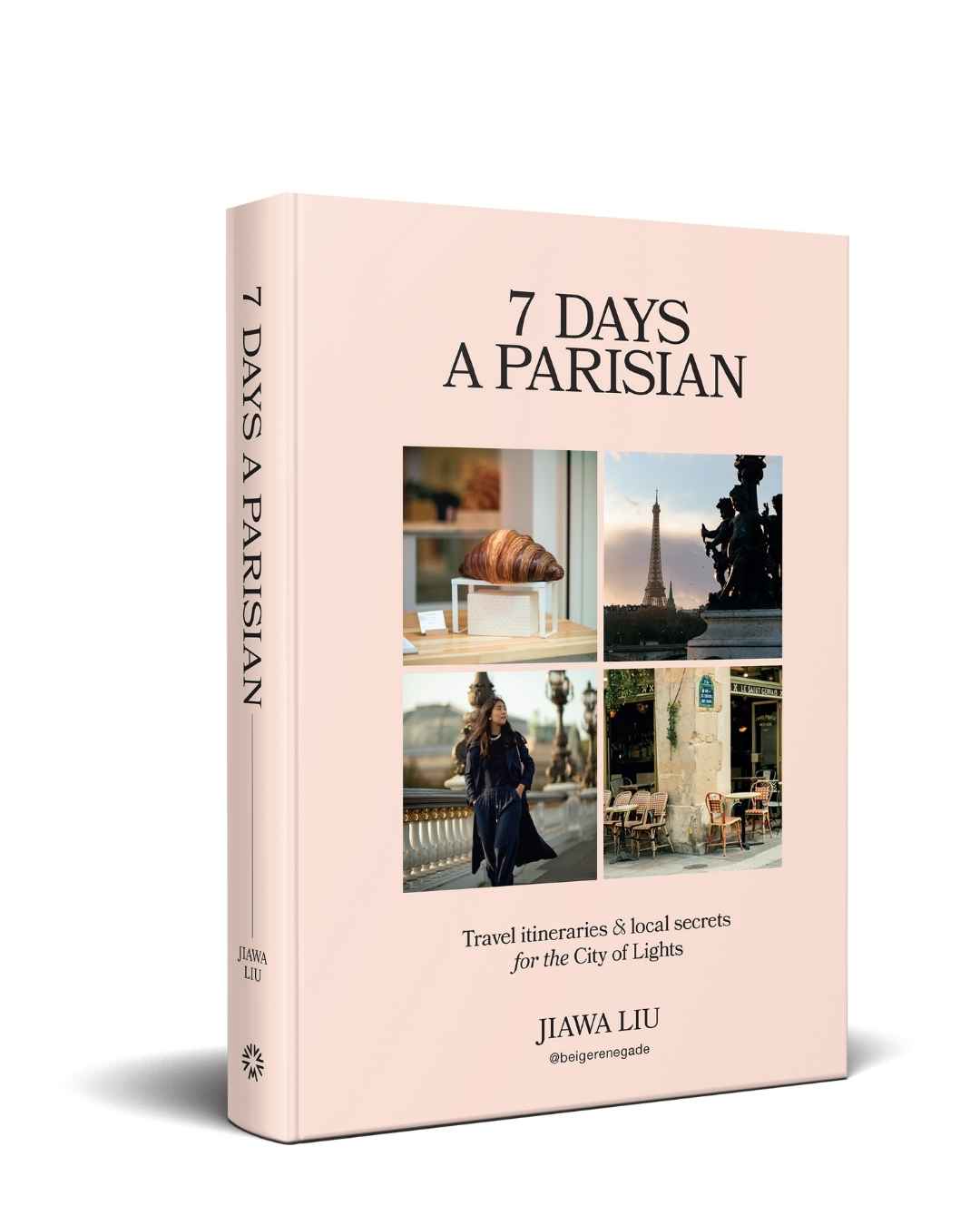
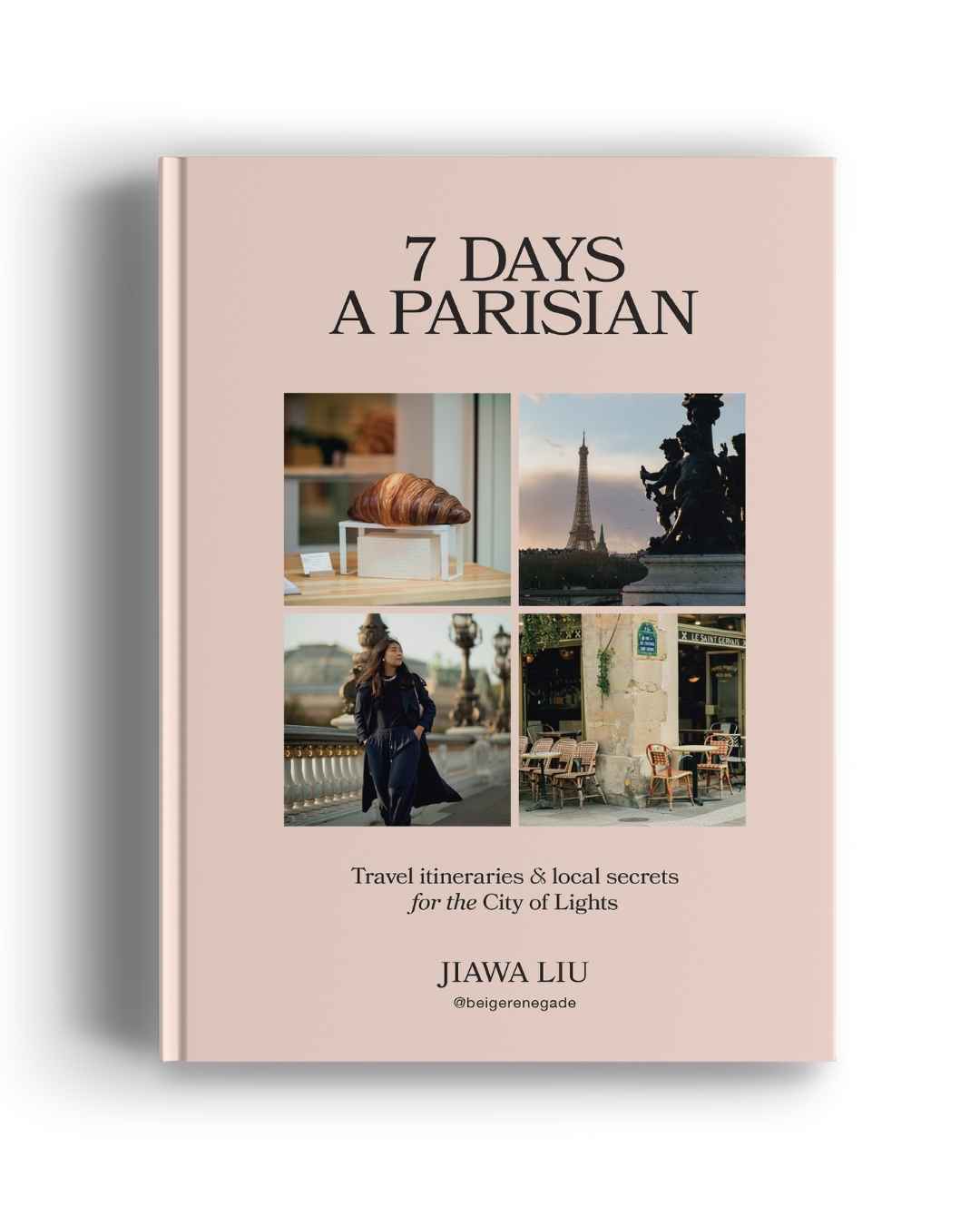
You’ve just written a book, 7 Days A Parisian, firstly Congratulations! It looks so beautiful - what compelled you to create this book?
My first book, '7 Days a Parisian', published with Murdoch Books, is a 340 page Paris guide book that not only shares some of Paris' best kept local secrets but also how I see Paris as a foreigner turned local.
I'd always had this dream since I was very young to write, and I had been able to do this as a blogger and fashion editor, but this project is quite different in that it's really a personal story. I never thought I would be able to be the author of a book, and the idea of doing a travel book was never something I thought about. About two years ago, my publisher Melissa from Murdoch Books wrote saying that, given my background as an Australian living in Paris, would I be interested in writing a Paris guide?
The original idea was something more simple, just a little compilation of some of my favourite addresses. But finally, this turned into two years of work, months of photography, writing, editing, and design, and I am extremely proud of it, and I'm so grateful to the Murdoch Books team who worked tirelessly with me on it.
The book is now on pre-order at major retailers including Amazon and Waterstones, and is launching in March 2026.
 |
 |
What is it about Paris - the architecture, pace, light, culture - that changed your sense of design, aesthetic, or rhythm of daily living? How did moving there shift or shape your creative lens?
The main premise of the book is 7 days of meticulously curated itineraries that I created, condensing my own journey from first time visitor to seasoned local. You begin the journey as a wide-eyed tourist, experiencing the most iconic, then you start to look deeper, delving into the inner neighbourhoods, experiencing Paris not just as a local, but appreciating its complex layers. I didn't want to cover everything about Paris, and I am not ashamed of being biased in how I see the city - this is really Paris through my eyes. The book contains over 170 addresses, many of which you will unlikely find in another travel guide or on social media, like amazing restaurants hidden in backstreets, and tiny ateliers and craftsmen on local corners that a visitor would never stumble on. But in the end the book is not really about its individual secrets, but more so, in the sum of its parts, the creation of a cinematic and emotive journey - how I remember my many years in Paris.
When you think of walking through Paris, perhaps your favourite route or moment, what sensory details (sound, light, texture) stay with you and inspire you, if any?
In Paris, we have a joke that you should always look up (and not down): the rows of mansard roofs under a pale blue sky, their windows, framed by wooden shutters, opening to countless little stories inside. On clear days the blue backdrop is crisscrossed with fluffy contrails, and every sunrise and sunset - not a single one ever being the same - the vivid colours fading from orange to pink, and red to violet, create picture perfect vignettes, where the grey-blue tiled rooftops and their crooked chimneys stretch into the horizon.
And if you look down? Labyrinth streets a nightmare to navigate, public spaces unkempt and stained (in what, it will not be mentioned), roadworks that go on for years, and overflowing trash cans - Paris is a place of stark contradictions, but a true lover sees beauty in this too.
Your style aesthetic has elegance but also a quiet autonomy. How do you define ‘luxury’ now, and how does that translate into your creative choices, your wardrobe, your photographs and your content?
Both in personal and professional contexts, I've done quite a lot of study on the concept of 'luxury', and I realise every time that the answer is quite simple: True luxury is comfort, and freedom and peace are the great pillars of comfort. I think our search for this is most of the time unconscious, and that's also why we gravitate towards products, content or experiences that represent these values, without even knowing why. If you had all the money in the world, I imagine that at first you will pursue material things (in the pursuit of external validation), but if you manage to achieve insight into your own motivations, you will probably give all of it away just to have true peace and freedom. I believe we are all this way, rich or poor.
In creative work, I express freedom, through pushing boundaries and conventions; in my wardrobe, I prioritise comfort; in my photography and content, I am drawn to images of peace, space and intimacy.
 |
 |
At Naturel Haus we think a lot about sensory experience (textures, rituals, slow-living), can you share a ritual from your life in Paris that anchors you and reflects a refined, quiet luxury?
I'm the weird person who doesn't have many rituals or habits, like certain things I do every morning, or before bed - everyday is like a new blank canvas. The one thing that does anchor me is being in bed. It's my favourite thing, try to do as many things in bed as humanly possible.
In the book you explore Paris from your unique vantage point — can you share a story or moment from the book that surprised you, perhaps an insight about the city that you hadn’t expected when you first moved there?
I discover and rediscover Paris everyday, and in writing the book, I experienced a great second discovery of Paris, and this time from an academic point of view as well as sensory. In particular I learned a lot historically and culturally about the city that I never really thought much about. For example, Montmartre is my spiritual hometown, being the first place in Paris that I visited. In writing about this neighbourhood, I discovered that beyond being a quaint village in the hills, it was the symbolic heart of political and social conflict for many centuries that shaped the face of Paris today. There is a curious statue called 'Cavalier de la Bar' in a dog park of all places, that I always found particulier, and I finally looked up his identity - he is the last person to have been executed for blasphemy in France. This statue stands for the fight for religious freedom in France, and due to its controversial nature, was destroyed, rebuilt and moved many times, finally finding its home in an inconspicuous dog park, steps away from the Sacre Coeur cathédrale. Its modern location is really a symbol of a tacit truce between secular and non-secular French society, whose conflict still rages today below the surface. Now, visiting this dog park - which I have done for years to spend time with my doggy neighbours - has developed a new meaning.
In the shift to Paris you embraced more freedom, you speak of choice and autonomy. For many of our audience (especially those healing, re-aligning, in transition) that change can feel enormous. Looking back, what would you say to someone who is yearning to shift career/location/life style but feels stuck?
Thinking and planning too hard are the best ways to make sure we never make that big change. Of course change is always scary, but many of us won't even admit that what's stopping us is really the fear, and rationalise our hesitation as being 'practically' driven. I think that for people yearning for change, the act of change is so scary that they distract themselves with thinking about all the difficulties, risks and consequences involved, and in ruminating on the future, you feel like you're progressing, but in reality, we find excuses to make staying the same feel like the smart thing to do. Some of my biggest life decisions were made without second guessing, not because I like taking risks, but because I know myself, and I knew that if I gave myself time to think, I'd talk myself out of it. I think about how scared I was to jump the 2 metre diving board at the local pool when I was a kid. If I gave myself a moment to think about what I was doing, the distance of the fall, the sting of impact on my skin, the water in my ears, I became paralysed every time.
We at Naturel Haus emphasise conscious, non-toxic, regenerative living. How do you approach the ethical side of fashion, content creation and luxury?
It's the nature of my job that I see a lot of consumerism and consumption, and often what I see is that people are not buying a product, but trying to become something or someone that they want to be. But no matter how much they buy, they don't feel any different in the end. The truth is products don't make us who we are, they can only serve who we are. So knowing who we are comes first. Once you have that concrete sense of identity, you will naturally find that you no longer need so many things, that you will choose the best for yourself, and what speaks the most to you, what makes you feel good, and newness doesn't seem so attractive anymore.
Your book also includes lifestyle advice: packing, dressing for the seasons, etiquette, and navigating the city with ease. How do you integrate aesthetic choices (what you wear, how you move through the city) with values of authenticity - and how might this translate for someone designing their environment (home, travel, daily rituals) to align with conscious living?
The lifestyle advice in my book is either simply about being practical and comfortable, or becoming Parisian in the most tongue in cheek sense. I think being authentic also includes not taking anything too seriously. For example, my 'how to be Parisian' commentary is not really about how to be chic and stylish, but empathising with certain idiosyncrasies of French-ness that are not necessarily positive - like their refusal to give a compliment, or their obsession with bread. We're not here trying to be perfect, just to embrace who ourselves and those around us, for who we are.
What would be some advice you would give your best friend about how to ground yourself when living in a big city? Any rituals you swear by for your wellbeing?
I think the most important thing is to design your life how you truly wish, wherever you are. People often say that Paris is very hectic and crowded (especially with tourists), that people are rude and aggressive, and that moving around is a nightmare. I can honestly say that I don't experience any of this at all. I can work from anywhere, with my team mostly working from home, so I don't have to venture into crowded places, commute to work, or even deal with a lot of people on a daily basis. My boyfriend, who has a beautiful denim brand (Superstitch) and a boutique in Paris, for example, sees a completely different Paris to me.
As someone who so beautifully embodies the art of living well, is there a piece of wisdom or a lesson you’ve learned along the way that you’d like to share with our readers?
I think the best thing you can do for yourself is to at one point in your life try to understand, once and for all, what are the most important things in life for you? Of course, this is probably the work of a lifetime. But imagine spending years rushing around pursuing your ambitions, without even knowing what the ultimate goal is. That's more scary to me than anything.
 |
|